Monday, May 6, 2019

Downsizing the studio space

I totally procrasti-cleaned last week. You know. When you clean instead of doing the work you’re supposed to be doing. I still did work I was supposed to do later, but not as much as I targeted to complete. I’m still happy with the choice. It had reached and point where I was losing time looking for stuff and moving things around. And I needed a “re-set” in order to stay focused on production. With downsizing to less than 250 square feet of studio space, it’s been a multi-year process of discarding and disposing of the items that are no longer serving me. I was more careful and mindful of selling this time. I've moved 11 times in 11 years and I went through multiple cycles of downsizing and upsizing throughout those years. 

I also figured out a piece of the organization puzzle that had been blocking me from progress. This particular "explosion" was the result of the last event I did. Last November. I've been trying to finish organizing my studio for my current focus but I go out to the studio. Sit on the couch. Get overwhelmed. Lay down and take a nap. And leave. Studio unfinished. Yeah.... it's been overwhelming, even for an organized mind...


I applied KonMari principles to my first round of studio organization and there is underlying categorization in this mess that still adheres to my original setup. But I'm finding I'm modifying KonMari principles for the studio space. Creatives need stuff to fuel the creativity. There are so many interesting ideas that come from the serendipity of one item landing next to another. Some of my most interesting ideas came from chaos. Austin Kleon cultivates his messy creative space. I personally live between chaos and orderliness. I love chaos for triggering interesting ideas. I love tidiness for production. 

My goal at this point is to re-organize my studio to grow my business (fulfilling wholesale orders) yet downsizing from a 400 sq ft studio space to 250 sq ft space. Here is how I'm using KonMari principles and how I'm modifying them for the creative as well as a downsized space.

  • Categories - THE most important principle I gleaned from Marie Kondo's approach is organizing by category. This has made all the difference to me in how I organize things. Especially as I work with small things (jewelry and beads), grouping like items together is a key to me finding things again. I very selectively break the principle when it comes to setting up my workstation; but generally, all like items are grouped together. As I'm organizing the studio, I will put like items in a single bin until that bin starts getting too difficult to find things, then I'll subcategorize.
  • Discarding - the big deviation I have from Marie Kondo on this is I reduce instead of "discard completely and all at once." So I can avoid the route of becoming a Hoarder (creatives see a use for everything), as I was setting up my smaller studio for business growth, I reduced the materials from various creative paths I've explored. I was able to sell a bunch in a craft yard sale. I gave some of it away. Some of it needed to be tossed the trash. I still have remnants of the ideas I tried, but I just kept the key pieces and the things I thought I would enjoy exploring again.
  • It's a Process - as someone who has gone through a cycle of upsizing and downsizing in (11 times in 11 years), discarding is more of a process than a "once and for all" for me. Simply from a financial perspective, I can't afford to buy, discard/sell, re-buy things. I'm much more mindful of the process. Which led me to my breakthrough step with the latest downsize.
    • Move 1 - major downsize from 1800 sq feet to 750 sq feet
    • Move 2 - downsize - 350 sq feet
    • Move 3 - upsized - 1200 sq feet
    • Move 4 - slightly downsized - 850 sq feet
    • Move 5 - slightly upsized - 1200 sq feet
    • Move 6 - upsized - 1600 sq feet
    • Move 7 - major downsize - 250 sq feet
    • Move 8 - upsize - 1100 sq feet
    • Move 9 - upsize - 1200 sq feet
    • Move 10 - upsize - 2300 sq feet
    • Move 11 - downsize - 500 sq feet
  • Staging - I'm at the final leg of discarding and downsizing and almost have everything at the right spot. But, I was struggling with the studio space, because what I had left was still cluttering the space (downsize from 400 to 250 sq feet). And I wasn't ready to get rid of it. After the yard sale, I had a bunch of very useful storage bins, but they were empty. I emptied as many as I could and took out all of the stuff that wasn't being used (lamps, storage bins, boxes, creative pursuits that weren't the focus). Just the visual clearing made a tremendous difference. But I wasn't ready to completely get rid of storage items. So, they are in a staging place in my living room. As I live with the newly organized studio space and finish re-categorizing for growth, I will selectively and carefully bring back in storage items. After 6-12 months, if I haven't used items in the staging area, then I will find new homes or discard some other way.

Now I can breathe. And find things. 


What about you? Have you used KonMari methods for your studio? How have you modified them as a creative?


Thursday, May 17, 2018

Effectively Efficient: Working efficiently and ergonomically

Production has officially started this past Sunday for 2018 Milwaukee Bead & Button. I’m starting very very late and have three weeks to create enough beads to sell.

Panic? 

Some tension but not panic. I just keep simplifying my plan. I had two very intense sessions on Sunday and Monday and produced 1,500 beads in those two days. The storms we had made me nervous to be in my shed so I took Tuesday off and Wednesday was a super low production day. 

The big thing I’m working out right now is ergonomics. There is a physical element to the way I’m working that I don’t have with an office job. I think there is an adjustment as I’m woefully out of shape. I also stand for multiple hours. My kiln is a few steps away. I actually prefer to stand over sit because I can move around a bit more. I would glue myself to a chair and move very little if sitting. 

Sunday, May 6, 2018

Effectively Efficient: Now I know why I was avoiding this task

Now I know why i was avoiding the task of setting up my shop with all of the beads and jewelry I've made. It's too complicated! After a 14 hour slog taking photos, editing photos, simplifying my shop categories, and uploading all the photos on Saturday, I finally have all but 35 necklaces uploaded to the shop and ready for my liquidation sale of the artistic meanderings I've been taking for the last few years. What that means for you, if you're reading this post, is a fabulous discount on my already low prices for sterling silver, glass, polymer clay beaded jewelry. I have some base metal components (copper) in some of the pieces, and super easy simple pieces strung on cotton cord - perfect for casual beach wear.


Making my processes efficient

One of the big learnings this year has been to simplify, simplify, simplify so I can be more efficient and serve my customers better. The net effect is that I can make my pieces and style much more cohesive and efficient. I'll be focusing on my best sellers for Bead & Button and using those as the foundation for my Bead Collections and my Jewelry Collections. It's still a lot of work, and it also happens to be work I really love and enjoy.

Studio Setup

In other news, my oxygen concentrator is in the "hospital" getting repaired. I had unknowingly abused it by working outside with it and then leaving it outside in the humid Florida weather. I learned that the sieve beds need to be rebuilt to get a decent flow of oxygen.

One of the benefits of problems is that it forces you to learn more about your setup. While the timing isn't great (I'm getting farther behind on bead production), I understand my setup much much better. Fixing the oxygen concentrator will make me more efficient in the long run.

And I learned more about safety, such as installing a flashback arrestor on the propane side of the torch. I like the cachet of doing an industrial art, but I am also still learning a lot about the safety. My torch is a surface mix torch and less prone to flashbacks, but it still can happen if I were to let the propane run out and then the flame would get sucked back into the propane line. Without the arrestor, it could, at a minimum cause the lines to explode. At worst, it could go all the way back to the propane tanks and cause them too explode. No thank you. Flashback arrestor please.


Monday, April 23, 2018

Effectively Organized: letting emotions affect your business

2017 - had a successful first ever bead and button show. Made a small profit my first year. Very small.

Then I lost momentum. Finances were painfully tight. I suffered an emotional setback that summer and I didn’t follow up that success. I stalled. Yet again. A hurricane diverted my attention to knitting for a few weeks and then I stayed in that rabbit hole while dealing with the emotional issues.

If you have a day job you do for others you put it on your game face and go to work and plod your way through the work. You may not be doing your total best but you slog your way through. 

You’ve got to do the same in your own business. There will be ups and downs. This is where systematizing, organizing and cresting a work plan will provide the stuff you need to keep doing. 

Creating randomly and freely and for fun can get short circuited with an emotional downturn. 

Effectively Organized: Bead Button was the best way to shift to production mindset

In 2017, I attended my first big trade show, Milwaukee Bead & Button as a vendor. Doing Bead & Button for the first time and not ever having been to the show helped me switch into production mode. Not seeing what other artists were doing, I didn’t have any pre-conceived ideas about how I should produce work for the show, set it up, display it, etc. I have been to bead stores and bead shows so I thought of what the bead vendors did. 

The lampwork artist I encountered at past bead shows gave me some ideas for a production approach, Grace Beads, but her business and production model is different than mine. Her beads are also beautiful and reasonable. I made a few necklaces pairing my simple beads with her decorated beads. 

I ended up creating a business model where I am somewhere between the artist and the mass bead sale vendor. I make lots the of the same beads, in collections. I also personally produce all of my beads. I do have a little help with the cleanup and presentation. 

I handmade all of my beads but I did large batches of the beads. I increased my efficiency and can make hundreds of beads in a session. I also keep it simple and focus on making spacers. Lots and lots of spacers. I took lessons I learned from 10 years of working as a hobby that the majority of my customers like the simpler beads. The spacers.

Blue Ocean Strategy

Not having been to Milwaukee Bead & Button before also allowed me to go blue ocean strategy instead of looking what the other artists were doing. I have been doing small craft and art fairs and keeping my production mindset small and geared toward OOAK work. 

In prepping for B&B I set a target sales goal. I broke out my trusty Excel and started figuring out how many beads I needed to make to achieve that goal. The biggest goal was to pay for the booth fee and travel expenses. I had already started making beads. When I did the math backward from my sales goal, I realized the way I was working and pace I was working at wasn’t sustainable and I wasn’t going to be able to make enough beads to even attempt my sales goal. Constantly “creating” has its limits. Not only does it create a mental drain for me, from the customer perspective, if everything is OOAK, it creates overwhelm. 

I then started doing collections. The same type of bead in different color combinations. I thought of the others in the art category and started with each set of beads being slightly unqiue. I checked my production plan and it still wasn’t fast enough. Then I defined 16 separate bead designs, 8 designs for glass and 8 designs for polymer and executed that plan in different color ways. Simplifying allowed me to scale up my production and I produced 10,000 beads for the show. 

Even my display ended up being unique. I wanted a card like a jewelry card to display. I saw an earrings display board on Rio Grande that was sort of like what I had in mind. I bought one as a sample and had my brother in law build out my display on risers and to my specifications. It’s a great modular display and I get a lot of compliments on it. It’s easy to see everything and browse. 

That plan was a success. I scraped out a teeny tiny profit my very first year. 

Creating cohesive collections with multiples of the same is a key to growth. However, my thinking is still too broad, as I’ve learned from this recent free training. I love simplifying the plan even more! I 


Hobby to Business Report: the Emotional shift of turning your hobby into a business

I think I might have blogged about this a while ago, but I’m in the throes of putting my head down and really working hard at converting an enjoyable hobby into a viable business.


I’ve been playing at being a real business since 2008. After about six months of awful glass beads I finally had some good beads that were worthy of sale. And I was relatively prolific. 

So much to unpack and explore in that post. Breaking it down. 

Sunday, April 22, 2018

Hobby to Business Report: Studio Time and your Roadmap

We all have different work styles and patterns. What works for one person isn’t as effective for another person.

As an artist we start with making art because we love it. We explore and meander down many paths.

When you start converting your art into a business you have to get more focused about studio time. 

For me, just setting studio time didn’t quite work. Creating the roadmap and the targets for which I was making items to sell helped defined my studio time. 

Tuesday, April 17, 2018

Effectively Focused: Starting to Spin

While I am making great progress on the shed studio, and getting the foundations in place to grow my business, I am getting to the same spot I always get to at this point... I start spinning.
  • Spinning in my mind with all the stuff I want to do. 
  • I find more classes that will “help me” do XYZ. 
  • Deciding what to eliminate to simplify and laser focus. 
  • Underestimating how long it takes to get something... anything... done. (The last thing to install in the shed is the ventilation. Important safety feature.) 
  • I want to store everything in the shed “neatly and perfectly” and got overwhelmed with the knowledge of how much energy and time it takes to divest myself of stuff. 
  • More classes
  • More designs
  • More art mediums 
And then I implode and go quiet for a while. 

Pix of moving into the studio shed...
moving into the shed


As I was chatting with Lisa on my last coaching call, she mentioned I have two big events that will be time consuming through mid-June. That caused me to create a two-year roadmap that I can view on a single page to keep front and center and not spin off into space and implode and stall progress on converting my hobby to a business. This is keeping me focused on the goals in front of me. 

Right now, I have three big things going on - finishing the shed, which needs to be completed before I can start working for the June Bead & Button show. And taking a class. Plus filing for a tax extension (and getting my bookkeeping in order) and doing a sale to liquidate my 2017 inventory.  

Okay five things. I’m focused on juggling three. I’ll layer in the other two when the studio is complete enough to start work. The other two don’t require 100% concentration. 

Seriously - this simple tool is keeping me focused on all the plates I have spinning and not trying to start any new plates spinning (still happens but it’s a little more controlled than usual). 

Side note: I might be creating a little bit of creative dissonance by throwing in a spreadsheet onto my art blog. But I am two people: the really artsy, relentlessly creative person and the hyper-organized business person who is addicted to Excel spreadsheets.

Your turn: do you have a tendency to spin? Are you an art hobby or art business? Are you trying to grow your hobby into a business? What tools do you use to stay focused?

Wednesday, May 10, 2017

Effectively Efficient: The Value of Production Work - Learning about Striking Reds

One of the things I'm learning with doing the same bead over and over and over is that I get to know the nuances of everything... the glass, my tools, my environment. In the first four mandrels I pulled from the kiln, I saw the clear evidence of the value of making the same beads over and over again to learn how to work the glass to gain consistent results.

A little background about the glass I use

I use glass from Effetre, and Italian glass company based in Murano, Italy. The other glass manufacturer I enjoy working with is Creation is Messy, an American based company working with a chemist in China that manufacturers the glass. Their colors fill in gaps on the Effetre palette. I also use Vetrofond (Italian) and Lauscha (German) in small amounts.

Learning about Striking Reds

As you can see, I did different things to the glass and obtained a variety of results from the same glass. That's because most reds in glass are what is called "striking" red... you get different results based on heating, cooling, re-heating, shaping, etc. Some of my earliest experiences with striking reds back in 2009 were extremely disappointing. I couldn't get any consistent results. But, I also didn't do a lot of experimentation. I worked in small batches and kept moving on to new things. By making large quantities and doing very basic beads as I build up a stash for the Bead & Button show, it's forcing me to slow down and learn.

For the color family I created that I'm calling "Santa Fe" with Reds and Turquoises, I like the variety of results that are produced. But, when I get to a point where I want to create very consistent results (for example, if I wanted to create a set of transparent beads for a necklace), I need to pay attention to when and how I work the glass in the flame and how to work it so it produces the specific effect that I want.

I started using Lauscha Red but it wasn't quite the red I wanted and I found my stash of Creation is Messy Sangre. Creation is Messy has a range of red colors, but this is their base color and it is much more consistent and easy to strike and get pleasing results than the other reds I was working with (well, for me, as a newer glass artist).

The top mandrel is the closest to the original rod. The second mandrel shows the three different results you can get from the dark burgundy red, the transparent red, and the basic opaque red.


Research on how to create colored glass

Here was an interesting article on the basic formulas to achieve different colored glass. In the lamp work world, we rely on manufacturers to come up with the formula for the glass colors and we buy rods of glass in those varieties.


This last mandrel with the tiny spacers shows how light the glass can get... I have some beads that are so light they are almost clear with a slight orange/yellow tint. Some are yellow. These show orangey-red. If you're trying to show a more dynamic color way, this is a way to get those high lights and low lights and a range of colors around a base color. 


More information from highly experienced artists

Creation is Messing - testing page 
Laura Sparling
Kandice Seeber - Color Addiction

Working with striking reds has been a huge learning experience.  and I look forward to another long play session as I get to know this valuable tool of working with striking glass to achieve the results I want.

Wednesday, June 8, 2016

Effectively Organized: The Messy Workspace


How does your creative space look? In this scenario, this is an area where I start cleaning and then I don't get any further because I get distracted with something serendipitously falling next to each other. Food is a distraction so I shovel food into my mouth and pile up the plates while I pursue the ideas in my head. Once I start working and creating, my tidy space turns to complete chaos. I love the interesting juxtaposition of random things falling in place next to each other. For me, chaos sparks my creativity. 

But, when I want to get work done, I like tidiness. This studio space KonMari-ed, but it's still too much designed for a hobby not a business. While it was easy to hit the "re-set" button on the space and put things away, it wasn't as conducive to large production as I needed it to be. 


Thursday, May 26, 2016

Effectively Organized: The Life-Changing Magic of Tidying Up - Home Tour of Office and Living Area


The last post in the series about Marie Kondo's book, "The Life-Changing Magic of Tidying Up." 

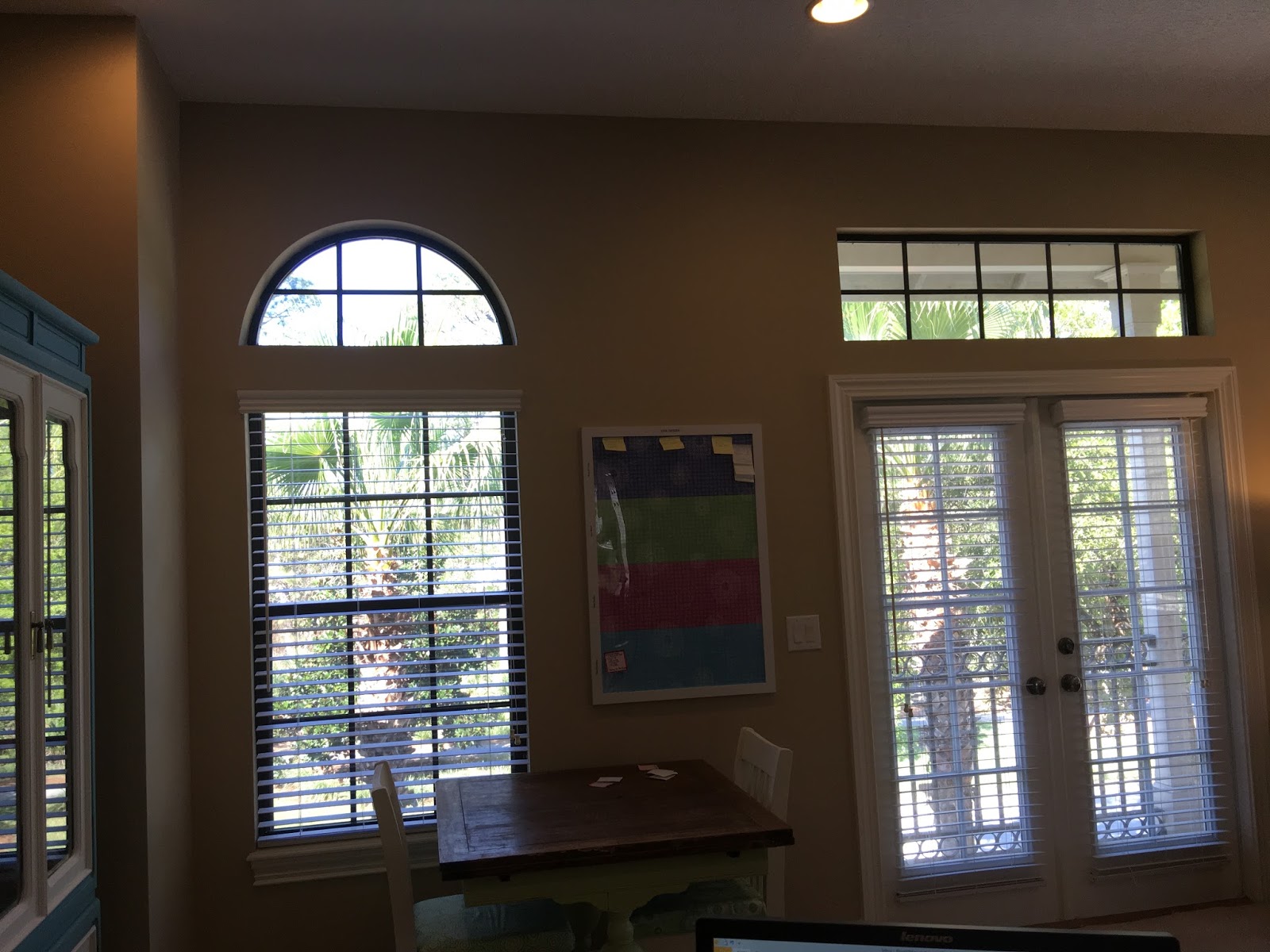
The first picture is the view from my desk while I work my day job. Overlooking palm trees! Check. This is the view that took my breath away when I toured this town home for rent. So grateful to have this place to work from.


And now a few views of how I've set up my office space. The yarn hutch is prominent in the background. I also have my Sticky Note PM post it boards (and matching sticky notes) as part of my office. I originally had my desk across the room, but I wanted easier access to my post it note boards and set up a dresser behind my desk for storing most of my office supplies and as a printer stand. If you look closely, you can see Trixie in her drawer.


The living area.


Tuesday, May 24, 2016

Effectively Organized: The Life-Changing Magic of Tidying Up - Home Tour of Studio Area


This is the last installment in the series of Tidying up and I end with the reason I started the whole process - my art studio. I've had my art studio organized in many ways in the many places I've lived in the last five years. But none of it really worked for me until I understood Marie's basic principle of "store like things together." Now, even though things are piled together and I have to look a little bit, I don't have to look hard to really find what I want. Jewelry findings and beads are stored together. Wire and chain. Polymer clay. Jump rings. Silver wire. Seed beading. Inks. Sewing and fabric. 

So, even when I'm in the middle of creating a giant art mess, when I put it all back, I can find it because I know where it needs to go. Such a crucial element of organizing. 

One other thing I did when putting together my studio was creating a space I was inspired to be in. That meant painting all of my furniture to coordinate, reupholstering furniture, finding pieces that filled a need (like the green dresser that serves as my shipping station). And now the result... updated since the last photo (different table).


Friday, May 20, 2016

Effectively Organized: Developing a Cadence

One of the things that is a major shift for me going from a hobby business to a real business is getting into regular habits of doing things that I might not like doing and maintaining the habit. As a hobby, you can flow with your moods. As a business, consistency is the lifeblood of making your business sustainable and profitable. I'm not profitable yet, but consistency leads to sales which leads to profitability.

Blogging

For me, blogging and newsletter are two parts of my ongoing marketing plan. I've been trying to create an editorial schedule, but this is a bit of an experiment to see what works best for me. I ha e broken my posts down into categories:


  • Hobby to Business Report: musings on what I need to do to move my hobby business into a real business that will eventually be how I make my living. I explore legal aspects, bookkeeping, mental shifts, posts like this one of moving from random posts to more organized, edited, and planned
  • Studio Time: behind the scenes of work, new work, the process of exploring new styles and mediums. I really like having a log of my history as an artist and my blog has been the main place for documenting my artistic journey.
  • Organized artist: this is an interesting area of exploration for me. I recently KonMari-ed my entire home and art studio. This is enabled me to start doing more in less time. I also created a project management system that utilizes sticky notes. It's based on what I've learned as a project manager (Scrum Master) in my day job. I also made functional art that support this. 
  • Throwback: looking back on my history as an artist or other adventures.
  • Design Exploration: sharing the process of creating surface pattern designs
  • Creative Finds: sharing any book, blog, Instagram feed that I loved or find inspiring
  • Funny Friday: usually stories about being a klutz
  • Resident Adventure: photographic explorations that inspire me and my art

I have been debating whether to have a specific theme for each day of the week or just blog organically. Right now, I'm blogging organically as having the specific theme for each day wasn't really working for me since my cadence is still at 2-3 times per week.


Newsletter

I really, really want to maintain a once per week newsletter cadence. I'm starting to get great feedback and engagement from my small list. However, there is a lot of work to updating the shops for the new color. I'm struggling with staying mentally engaged and interesting for a weekly newsletter. Bi-weekly makes more sense right now where I'm at. Lately the cadence has been 2 weeks on, 1 week off. I don't know if that's confusing though.

The other challenge right now is that I've had lots of visitors in the last two months, I'm trying to improve my personal nutrition and exercise habits (and layer those activities in).

I don't have an answer for this one at the moment. I'm sure I'll more thoughts later.

Wednesday, May 18, 2016

Effectively Organized: The Life-Changing Magic of Tidying Up - Home Tour of Bedroom, Laundry, and Kitchen

Continuing the home tour of my very organized home, I have to say having my home organized this way makes it so much more efficient and easy to find stuff. 

Although Marie advocates getting rid of stuff and promotes a more minimalist mindset and I did get rid of a lot of stuff, she also advocates keeping only things you love. In my case, I brought in things I loved - like art and useful pieces of furniture. I wanted my home to feel cozy warm and inviting... and my guests that I've had since I put my home together this way have all said it is very inviting and relaxing... just want I want for my guests to feel. I didn't get any more than I needed, to make my home feel this way and almost everything is second hand. Very little is brand new. 

Laundry Room / Utility Room

I have a little snap of my laundry room. In those cabinets are where I store most of the things I need in my house that are utilitarian: paints, paint supplies, light bulbs, towels, kitchen towels, cleaning rags, cleaning supplies, laundry supplies, and tools. I have always had trouble finding what I needed of these types of items when I needed it. By storing this all in one place, I now can find things I usually can't. It's uh-may-zing.


Entry Way

A useful table and place for keys, functional wall art to hold sticky notes for my chores and home things I need, plus art from Australia and Hong Kong, and a wall hook for coats, scarves and dog leashes. I'm actually getting very consistent about leaving my keys in the same spot, hanging up my coat and putting Trixie's leash away in the same place.


Kitchen

One major thing I did for my kitchen was get rid of all the junky pots and pans that I didn't like or care for and then I invested in good pots and pans that I love love love to cook with and also happen to make my kitchen a happy, inspiring place to good healthy good food. My only mild complaint with the layout of my kitchen is the very, very limited counter space. It's very equivalent to the counter space I had in my Hong Kong kitchen...it's slightly more, but not much. I love a big giant island. But, other than that, I love this kitchen for having a gas stove. That is something I learned to love living in Hong Kong - gas stoves. My pantry and cabinets are very organized and I have dishes and pots and pans and cutlery that make spending time in this kitchen really pleasant.


Power Room

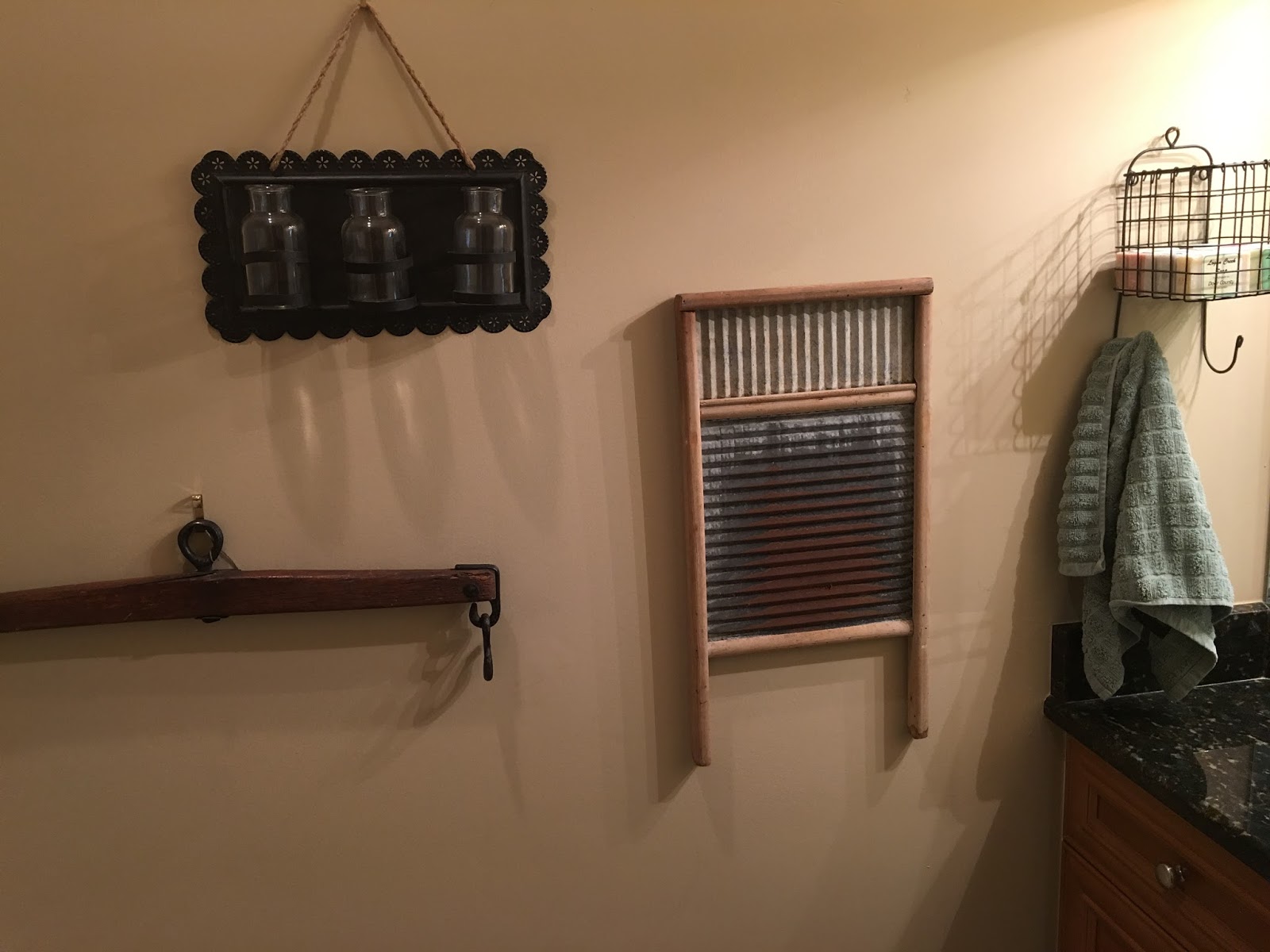
Some art and misc. flea market / online finds that make it a little more interesting and less bland.


Master Bedroom

This is how my master bedroom was last year. Very simple, minimalist, and neat. But it didn't seem "right." And then I realized the scale was off. This is a very large bedroom. The furniture I had was designed more for a regular size bedroom. I had been wanting to find a white farm house bed, but couldn't find what I liked.


Then I found a bedroom set at a re-sale shop that had a look that was close to what I originally had in mind. I set it up even though I still had my queen size mattress. :-) I know it looked silly, but I loved having the headboard and side tables. I tend to stack my night stands high with books and ideas and projects. These 3 drawer stands were perfect for me.


I finally got my king mattress and set it up.


The huge benefit of all of this organization is that it's now much easier for me to find things, put things away consistently, keep it neat, tidy, and clean. For the first time in my life, I've been able to be consistent with this even though my home is relatively large for me and keep up with it fairly well. I credit the KonMari method for helping me refine my own methods of organization.

Friday, April 29, 2016

Effectively Organized: The Life-Changing Magic of Tidying Up - Home Tour


So, I've finally Kon-Mari-ed my entire house. I organized, painted, upholstered, hung art and now my home is a pleasant, cozy space. It's also organized enough that I can find things easily on a regular basis. Yep. I believe in Marie Kondo's method of organizing. Most of the art I have in the house is art from other artists. If I know the artist, I'll link them. I'll start this post with guest spaces. 

Guest Space #1

I painted the dresser, tables, and head board in Annie Sloan chalk paint. The pillows are from my Zazzle shop. The driftwood whale was from a local art show in St. Augustine. The painting on the wall is one of my own textured canvas color washed in blues. I'd like to learn how to reupholster the chair in some of my fabrics at some point.  


Guest Space #2

The quilts in this guest room are by Rose Ann Points of Delightful Little Things. The bed frames, tables, and lamp are Craig's List finds. The wall hangings are random things I've found here and there. I've decorated this room specifically for my nieces to stay over with me. If I have two sets of couples, one of them gets the "Dick Van Dyke" show guest room. :-) It works nicely for families though.


The chest below is my mom's child hood chest. It got passed around the family and I finally repainted it. The chairs are some beautiful finds from Eco Relics up in Jacksonville. And the beautiful butterfly is by Mandy Saile. I have several of her original art works. Her bright, happy birds and butterflies make my home so happy.


Guest Bathroom

The poppies painting are by my friends Brenda Liz.The cute little birds are by my friend in Michigan. The sea turtles are made in Haiti of upcycled steel drums and can be purchased in one of the local art stores called Amistad.


The wall hooks for the towels are another driftwood creation. The hummingbird is another Mandy Saile creation.


More hour tour in a future post.

Friday, April 22, 2016

Effectively Organized: Shifting Mindsets - Production Mindset

I was just reflecting on the process of turning my hobby business into a real business, that it is as much about shifting mindsets as it is about implementing systems. Christine Kane addresses some major mindset shifts that need to happen in order to become an effective business owner. Here is her short list - but the whole post is worth the read. 


  1. When you were an employee, you had a boss.
  1. When you were an employee, you had deadlines.
  1. When you were an employee, you had to, you know, not wear pajamas to work.
  1. When you were an employee, you didn't have to market.
  1. When you were an employee, people cared about the letters after your name.
  1. When you were an employee, you just walked in and did your thing. Big picture, schmig picture.
  1. When you were an employee, you didn't have to invest in you. The company invested in you.
Silver and Copper Twig Earrings (multiple pairs of a design)
What about you? Have you found a need to shift your mindset as you develop your creative business?

Frankly, I'm not even that far along in my shift from hobby to business. I’m still back in areas like moving from just creating randomly as because I want to and shifting into production mode (i.e. setting up systems to make enough pieces to sell, and being efficient about making larger quantities).

For me, my hobby has been a de-stressor and a way to relax. And this is something that is worth looking at carefully. Often we start a hobby and start creating so much we have to sell it to offload the amount of stuff we have made because we're running out of friends to give things to and to support the stash we've bought into. [Cough, cough - that's been my hobby business so far.] If you want to stay in a small, a hobby business, it is perfectly acceptable. BUT. If you want to turn your hobby into a real business you have to start thinking differently. About pricing. About marketing. About production. About income. About strategy. About production and production efficiencies. About contracts. About taxes. About setting up legally and correctly to run within the parameters of the law. Those are a lot of mindsets to shift and rewire in your brain!

For this post, I'm going to dive into...


Production Mindset


Production Mindset could also be described as "how to make enough product to support myself." In 2012, I started exploring seriously moving my hobby into a real business. I took some advice and started working backwards: I figured out how much income I needed to live and started working backwards to figure out how many pieces of jewelry I would have to make and how much I would have to charge in order to support my life. Even simplifying as much as possible, it was a little... um, shocking... to see how much I would have to make and sell The making part had it's own mental hurdles, but the selling part was even more of a mental block. I realized in a saturated jewelry market, I could only sell so much. I needed to look at expanding my options of what I could sell. (Exploring multiple income streams is a subject for another post.) But, I still like making jewelry and do want this to continue to be an income stream for me.

Fast forward to 2016, tiny little movements forward in the business (like setting things up in the background to run as a real business), but little to no studio time in between. Now, I'm starting up studio time again and I’m finding some odd words creeping up in my vocabulary as I shift into business mode and re-wiring my brain to be a responsible business owner. Things like “dread,” “tied down to my workspace,” “trapped.”

I mentioned these things in my last Master Class coaching call with Lisa Call, and she said I needed to journal about it. Which I have done, but I thought it was worth sharing in a public forum. Perhaps you are a hobby artist who is trying to making a go of your business.

Exploring my mindset and reframing my fears

Regarding being "trapped" at my studio desk - I realized I have total freedom over my work space and can redesign my space to be enjoyable. I may not be able to sit on my couch and make whatever I want whenever I want, but I can still design the space to be efficient and motivating as well as beautiful and inspiring. That's actually something quite wonderful about working for yourself - you have control over your environment that you don't always have in a regular job.

Exploring another aspect of those depressing words, I realized the feelings behind those were fear. Fear of not being good enough, fear of being a disappointment to my customers, fear of not being able to keep up with the schedule and amount of art I needed to make. And the good news is that as I break those fears apart, I realize I can do something about all of that. Starting small lets me make mistakes, and work out the kinks in my business and systems, before I grow. It lets me organize and create systems to make sure I can handle each of those things that may crop up. 

Regarding not being good enough, I can experiment wildly and develop my style and find a style that resonates both with me and with others. Regarding disappointing customers, I can work slower and smaller to make sure I can make my customers happy. I can experiment with custom work to get a feel for working closely with customers. I can develop customer service systems that help maintain a relationship even after a disappointment. 

Regarding the fear of keeping up, well, this is a valid fear, but this is part of the reason I want to keep my business small and grow carefully. I want to figure out what works, what is sustainable for me personally. I want to keep my business simple, sustainable, and manageable as a one-person operation. 

What about you? Are you transforming your hobby into a business? What mindset shifts have you encountered?

Monday, March 21, 2016

Effectively Organized: Lessons from my first show

My mom hosted a small mixed media show for our friends last week. Here were some of my basic lessons from my first ever show.

Lessons:


  • This was my first real show ever. It was good practice to pack, set up, figure out what worked, what didn't, break down and go home. That was a lot of work! I celebrated by taking naps for the next 2-3 days after work. LOL


  • One really great opportunity was having the opportunity to practice speaking and explaining all the pieces without being apologetic or minimizing my work.


  • I need to have a greater range in price points. I like to work in higher end materials. For small shows where I can expect people to look for small, inexpensive items I can still work in the higher end materials but make simpler pieces of jewelry.


  • My completely handmade items went over better than the designs I had printed by a third party. I'm not quite sure of the reason other than, that's just the way it went for this show.


  • Being able to explain my jewelry and that I only work with Sterling or Argentium silver was important. I need to display the materials in tags on the specific pieces or as a grouping of pieces. Also, I loved being able to say I made the glass beads - they are so pretty, even when they are simple spacer beads. I really look forward to getting back to lamp working. 


  • Wear my hair up! I'm too hot with packing up and setting up to do anything else. I'm in Florida! But even if I was in a cold weather state, I just get hot.


  • I need to figure out a better post-show routine. I loaded my cabinet back up, but there is still stuff all over the table from making jewelry and it's a week later.